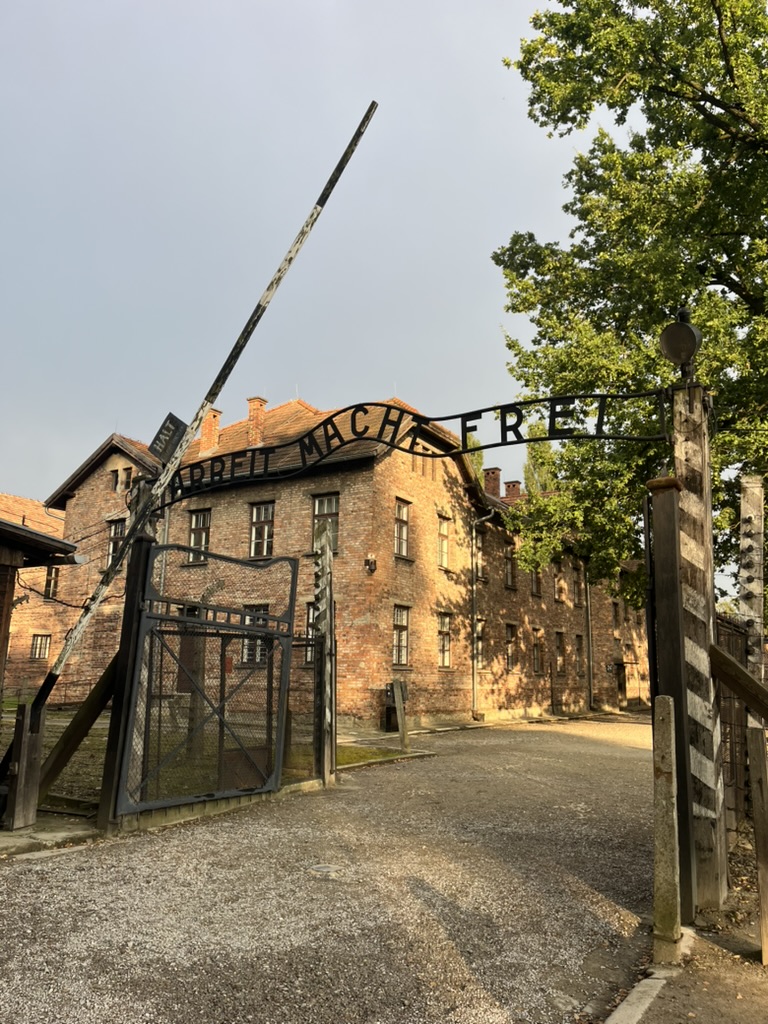
by Amy Houbé
It is important to remember that Auschwitz was not created in 1940 as an extermination camp. It began as a concentration camp intended primarily for Polish political prisoners. Through a series of decisions taken between 1941 and 1942, driven by the war against the Soviet Union, the demands of German industry for forced labor, and the radicalisation of Nazi anti-Jewish policy, it was transformed into the largest and most complex camp in the Nazi concentration and extermination camp system. Understanding this gradual evolution is essential to understanding the history of Auschwitz itself.
Understanding Auschwitz: a Journal from the International Summer Academy
Last week, I participated in the first level of the International Summer Academy (ISA) organized by the International Center for Education about Auschwitz and the Holocaust (ICEAH). It was my second time at Auschwitz, having previously spent a week volunteering in the museum archives through the Volunteer Academy. Although I was already familiar with the site, the lectures and guided tours provided new perspectives and a much deeper understanding of its history.
This series of articles is my attempt to share some of what I learned during the programme. Rather than recounting my personal experience, I want to present the historical knowledge and reflections I gained from the lectures, while highlighting the research of the historians who study the history of Auschwitz. My hope is that these articles will help readers better understand how the camp evolved, why it developed as it did, and why precision and historical context matter when discussing Auschwitz.
This first article focuses on the creation and expansion of Auschwitz I. Future articles in this series will explore other topics covered during the ISA, including forced labour, deportations, the process of extermination, and everyday life within the camp.
The origins of Auschwitz I (1940-1941)
During the first lecture by Dr. Piotr Setkiewicz, we explored the transformation of Auschwitz from a concentration camp for Polish political prisoners into the vast complex that would later become the largest centre of mass murder established by Nazi Germany. (See the series of books on the history of Auschwitz through archival sources, including Bartosik, Igor, and al. The Origins of the Auschwitz Camp in the Light of Source Materials. Państwowe Muzeum Auschwitz-Birkenau, 2018, 380 p.)
The creation of Auschwitz
On 1 September 1939, Nazi Germany invaded Poland, marking the beginning of the Second World War. Sixteen days later, on 17 September, the Soviet Union invaded eastern Poland under the terms of the Molotov–Ribbentrop Pact, leading to the partition of the country. At the time of the German invasion, the site that would become Auschwitz I consisted of former Polish Army artillery barracks on the outskirts of Oświęcim. Following the occupation, Oświęcim was not incorporated into the General Government, as Kraków was. Instead, the town was annexed directly into the German Reich and became part of the Province of Upper Silesia. The Germans renamed the town Auschwitz, the name under which it became known worldwide.
By late 1939 and early 1940, the Nazi authorities in Upper Silesia faced overcrowded prisons due to the mass arrest of members of the Polish intelligentsia, political opponents, resistance members, priests, teachers and other civilians. The initiative to establish a concentration camp in the region was proposed by converting the abandoned Polish military barracks into a concentration camp. On 21 February 1940, Richard Glücks, Inspector of Concentration Camps, inspected the site and considered it suitable because of its existing brick barracks, the possibility for future expansion, and its excellent railway connections. Following his report, Heinrich Himmler, Reichsführer-SS, formally ordered the establishment of the concentration camp on 27 April 1940.
A concentration camp for Polish prisoners
The camp’s first commandant was Rudolf Höss, who arrived shortly afterwards to organise the new camp. On 20 May 1940, a group of thirty German prisoners classified as “criminals” was transferred from Sachsenhausen concentration camp. They became the first prisoner functionaries (kapos) and were used by the SS to help administer the camp and supervise incoming prisoners.
The first large transport of prisoners arrived on 14 June 1940. It consisted of 728 Polish political prisoners deported from the prison in Tarnów. These men became the first registered prisoners of Auschwitz. During its first year, Auschwitz primarily functioned as a concentration camp for Poles, including members of the resistance, intellectuals, Catholic clergy, teachers, lawyers, civil servants and others whom the occupation authorities considered potential enemies of the Reich.
These prisoners were forced to transform the former military barracks into a functioning concentration camp. They expanded existing buildings, erected fences and guard towers, built roads, drained marshland, and laid the foundations for what would become a much larger camp complex. The work was carried out under brutal conditions, with inadequate food, systematic violence, disease and arbitrary executions causing high mortality.
The expansion of Auschwitz
The next major turning point came with the German invasion of the Soviet Union on 22 June 1941 (Operation Barbarossa). Even before the invasion, Heinrich Himmler had visited Auschwitz on 1 March 1941 and ordered a dramatic expansion of the camp. He instructed Rudolf Höss to enlarge the existing concentration camp and to build a vast new prisoner-of-war camp near the village of Brzezinka (Birkenau), initially intended to hold around 100,000 Soviet prisoners of war.
At approximately the same time, the German chemical giant IG Farben decided to build a large synthetic rubber (Buna) and fuel plant at nearby Monowitz. The company required tens of thousands of workers. Himmler agreed that concentration camp prisoners would provide this workforce, creating a close partnership between the SS and German industry. This cooperation eventually led to the establishment of Auschwitz III–Monowitz, while dozens of smaller satellite camps were later created to supply forced labour to factories, mines and construction projects throughout the region.
Beginning in October 1941, around 10,000 Soviet prisoners of war were deported to Auschwitz to build the new camp at Birkenau. Most of them died within a few months from starvation, disease, exposure, exhaustion, executions and systematic abuse. Only a small fraction survived long enough to continue working.
The beginning of mass murder in Camp I
During 1941, the function of Auschwitz also began to change. As the war expanded, Nazi policy towards European Jews became increasingly radical. On 31 July 1941, Hermann Göring authorised Reinhard Heydrich to prepare what the regime called the “Final Solution of the Jewish Question.” During the autumn of 1941, the SS carried out the first experimental killings with Zyklon B at Auschwitz in the basement of Block 11, initially using Soviet prisoners of war and sick prisoners. Crematorium 1 became the first gas chamber but this is a subject I will delve into later.
Bibliography:
Bartosik, Igor, and al. The Origins of the Auschwitz Camp in the Light of Source Materials. Państwowe Muzeum Auschwitz-Birkenau, 2018, 380 p.
Sawicki, Pawel and Piotr Setkiewicz. “The beginnings of Auschwitz”. On Auschwitz (podcast). Ep. 1. February 4, 2022.


Leave a Reply